
The 10 Essential Mental Health Skills You Need (Backed by Research and Real Life)
Most people think improving their mental health requires therapy, time, or a complete life reset. But for many—especially busy professionals and entrepreneurs—that simply isn’t realistic.
You have responsibilities. Deadlines. People depending on you.
You don’t always have the luxury to pause everything and “figure things out.” And beyond that, there are real barriers to accessing professional care—location, cost, personal preferences, quality of care, and stigma.
And yet… you still feel the pressure.
The stress. The mental fatigue. The emotional weight that quietly builds over time.
What Actually Works in Real Life?
So the question becomes:
What actually works in real life?
Not in theory. Not in ideal conditions.
But in the middle of a busy, demanding life.
You need support that meets you where you are—something practical enough to fit into your reality, and effective enough to help you keep showing up for yourself.
A Skills-Based Approach to Mental Health
Over time, through research, observation, and practical application, I’ve come to understand something important:
Mental health is not just something you have—it’s something you build through skills.
And like any valuable skillset, the difference between struggling and functioning well often comes down to whether you’ve intentionally learned and practiced the right ones.
And not just any skills.
These are the same skills I teach step by step in my masterclass, where the focus is on practical, real-life application—not just theory.
Across decades of psychological research—from cognitive behavioral approaches to workplace wellbeing studies—certain skills consistently show up as the ones that make the biggest difference in how people manage stress, emotions, and everyday challenges [1][3][4].
Are these the only mental health skills that exist? No.
But these are the ones that repeatedly prove to be the most essential—especially for people navigating high-pressure, real-world environments.
The Right Mental Health Skills
This is where they become not just helpful—but essential. You came here looking for help with stress, burnout, or mental health… but what you actually need are essential mental health skills.
The 10 essential mental health skills are:
- Emotional Regulation
- Stress Management
- Resilience Building
- Boundary Setting
- Problem Solving
- Positive Thinking
- Self-Awareness
- Self-Care
- Effective Communication
- Social Support
The 10 Essential Mental Health Skills
1. Emotional Regulation
Your ability to understand and manage your emotions—rather than being controlled by them.
This skill sits at the core of therapies like Cognitive Behavioral Therapy (CBT) and Dialectical Behavior Therapy (DBT), both widely used in managing anxiety, depression, and emotional distress [1][2].
When this skill is missing, stress escalates quickly. Reactions become impulsive. Decisions become clouded.
When it’s present, you gain stability, clarity, and control—even in difficult moments.
2. Stress Management
Stress itself is not the problem—research in stress and coping shows that how you respond to stress is what determines its impact [3]. Unmanaged stress is the real problem.
This skill helps you recognize stress early, respond effectively, and prevent it from becoming chronic.
For anyone living a busy life, this is non-negotiable.
3. Resilience Building
Resilience has been extensively studied in positive psychology as a key predictor of long-term mental wellbeing [4].
It’s what allows individuals to adapt, recover, and continue functioning despite challenges.
It’s not about being unaffected. But it’s about being able to bounce back.
4. Boundary Setting
Occupational health research consistently links poor boundaries to burnout, emotional exhaustion, and reduced productivity [7].
Many people are not overwhelmed because they have too much to do.
They’re overwhelmed because they have no boundaries.
This skill helps you protect your time, energy, and mental space—without guilt.
5. Problem Solving
Structured problem-solving is a core component of many evidence-based psychological interventions, particularly within cognitive-behavioral approaches [1].
When problems feel undefined or unmanageable, anxiety increases.
This skill gives you a way to break challenges down, think clearly, and take action—restoring a sense of control.
6. Positive Thinking
Research in cognitive psychology shows that our interpretation of events—not just the events themselves—shapes our emotional experience [1][4].
Positive thinking, when grounded in reality, helps shift unhelpful thought patterns into more constructive ones.
It’s not denial. It’s direction.
7. Self-Awareness
Self-awareness is a foundational element of emotional intelligence, widely studied in both psychology and leadership research [5].
Without it, change is difficult.
With it, you gain the ability to recognize patterns, adjust behaviors, and respond more intentionally.
8. Self-Care
Preventive health research continues to show that consistent self-care practices reduce stress and protect against burnout [6][8].
Often misunderstood as indulgence, self-care is actually maintenance.
Without it, everything else eventually becomes harder to sustain.
9. Effective Communication
Studies in relationship and workplace psychology highlight communication as a key factor in reducing conflict and improving mental wellbeing [7].
Unspoken stress and unresolved tension don’t disappear—they build.
This skill helps you express, listen, and connect more effectively.
10. Social Support
One of the most consistent findings in mental health research is this:
Strong social support is one of the most consistent protective factors against anxiety, depression, and stress-related conditions [8][9].
No one thrives in isolation.
It’s not about having many people—it’s about having meaningful support.
Why These 10 Skills Matter
What makes these essential mental health skills powerful is not just their individual impact—but how they work together.
Some help you manage your internal world—your thoughts, emotions, and reactions.
Others help you navigate your external world—your relationships, responsibilities, and environment.
They are not categorically independent—they are interdependent, reinforcing one another and forming a complete system.
In real life, this might look like this:
You’re overwhelmed at work and close to burnout.
Without self-awareness, you may not even recognize how much pressure you’re under.
Without boundary setting, you keep saying yes to more demands.
And without emotional regulation, your stress spills into frustration and exhaustion.
But when these essential mental health skills work together, the experience changes.
You recognize the pressure early. You set clearer limits. And you respond instead of reacting.
Also instead of spiraling, you steady yourself and move forward with clarity.
It can show up in your personal life too:
You’re dealing with tension in a close relationship.
Without effective communication, things go unsaid or come out the wrong way.
Without emotional regulation, conversations quickly turn into arguments.
And without positive thinking, you may start assuming the worst about the other person.
But when these essential mental health skills work together, the dynamic shifts.
You express yourself more clearly. You listen with more intention.
And you manage your emotions in the moment—choosing your response more carefully.
Thus, instead of the relationship breaking down, it begins to strengthen.
This is what it looks like when the right mental health skills are not just understood—but applied as a system.
Together, they reflect what research across multiple fields has already shown:
Mental wellbeing is not built from one factor—it’s built from a combination of skills [4][8].
Not a theory. Not a trend.
But a practical system you can apply in everyday life.
A Different Way to Think About Mental Health
For a long time, mental health has been approached as something to fix when it goes wrong.
But what if we started earlier?
What if, instead of waiting until things break down, we focused on building the skills that help us stay steady in the first place?
Because the truth is:
You don’t rise to the level of your intentions. You fall to the level of your skills.
For Busy Lives, This Matters Even More
If your life is demanding, you don’t need more information.
You need what works.
Research in workplace wellbeing continues to show that professionals perform better—and experience less burnout—when they have practical tools to manage stress, regulate emotions, and maintain balance in real time [7][8].
That’s what these 10 essential mental health skills are designed to do.
You don’t need to wait until things fall apart to take your mental health seriously.
You can start building the skills that support you—every single day.
Ready to build these skills in your own life?
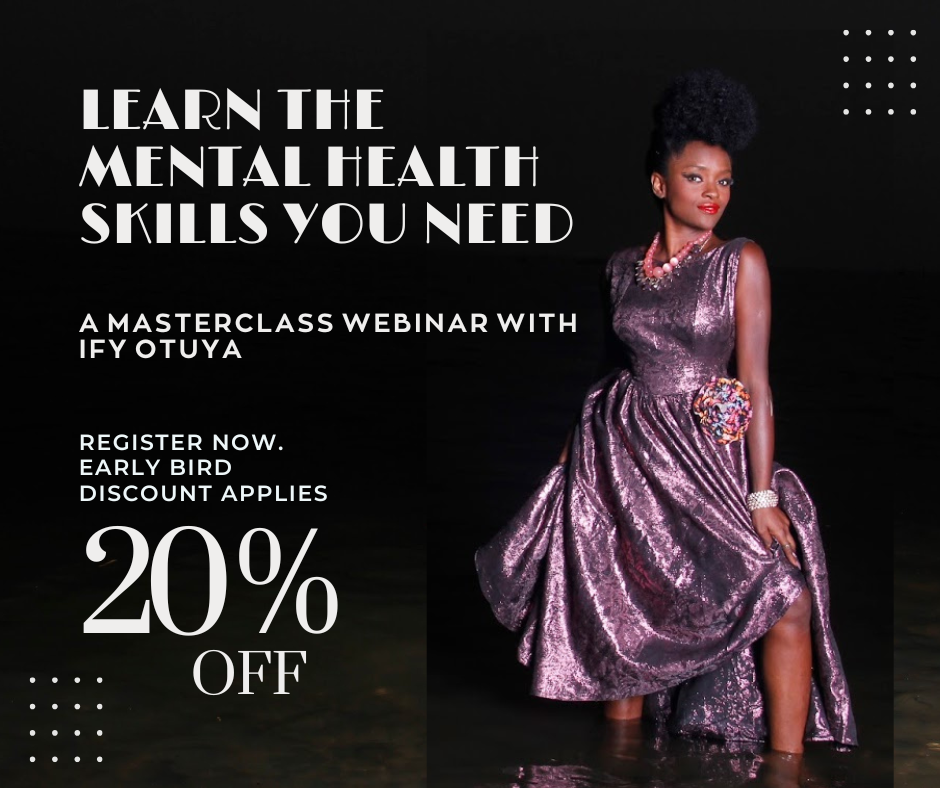
My Learn the Mental Health Skills You Need masterclass gives you a clear, practical overview of the 10 essential mental health skills and why they matter—so you can navigate your challenges with more ease and grace in your daily life.
If you’re ready to go deeper, I also run focused workshops where we explore one specific skill at a time, from the 10 essential mental health skills, and learn exactly how to apply it in daily life.
And for those who prefer personalized guidance, I offer one-on-one Mental Health Advisory sessions tailored to your needs. This isn’t therapy—it’s practical, skill-based support designed for real-world challenges.
Take the next step and choose the level of support that fits you, so you can overcome your mental health challenges, live better and feel happier in your daily life.
📞 +2348086204343
Take the next step.
References & Research Foundations
This article draws on well-established research and frameworks across psychology, mental health, and workplace wellbeing, including:
[1] Beck, A. T. (1979). Cognitive Therapy and the Emotional Disorders.
[2] Linehan, M. M. (1993). Cognitive-Behavioral Treatment of Borderline Personality Disorder.
[3] Lazarus, R. S., & Folkman, S. (1984). Stress, Appraisal, and Coping.
[4] Seligman, M. E. P. (2011). Flourish: A Visionary New Understanding of Happiness and Well-being.
[5] Goleman, D. (1995). Emotional Intelligence.
[6] Neff, K. (2011). Self-Compassion.
[7] Maslach, C., & Leiter, M. P. (2016). Understanding the Burnout Experience.
[8] American Psychological Association (2023) – Work in America Survey https://www.apa.org/pubs/reports/work-in-america/2023-workplace-health-well-being
[9] World Health Organization (2022) – WHO Guidelines on Mental Health at Work
https://www.who.int/publications/i/item/9789240053052
https://www.who.int/news-room/fact-sheets/detail/mental-health-at-work
Author’s Bio:

Hi, I’m Ify Otuya, a mental health advocate and speaker, and also the founder of June E-waste Academy. With expertise in entrepreneurship, my background lies in the arts, e-waste management and marketing. Through my advocacy, I have empowered many to confront mental health challenges and find hope in their journeys. I create articles and empowering mental health recovery stories to inform, grow empathy and compassion for individuals with mental health challenges and to destigmatize mental health.
I am currently building my community to bring hope and to inspire others to live their best lives today. To schedule me for a speaking event or interview, kindly email me at: missotuya@gmail.com. Visit www.ifyotuya.com to join me on my journey towards a mentally fit future for all.
I appreciate how well-researched and informative each post is It’s obvious how much effort you put into your work
I have been struggling with this issue for a while and your post has provided me with much-needed guidance and clarity Thank you so much
I appreciate how this blog promotes self-love and self-care It’s important to prioritize our well-being and your blog reminds me of that
Your blog is a great source of positivity and inspiration in a world filled with negativity Thank you for making a difference
Thank you for sharing your personal experiences and stories It takes courage to open up and you do it with such grace and authenticity
Wow, this blogger is seriously impressive!